
Non-GST Credit Notes: When a "Commercial" Credit Note Is the Right Call
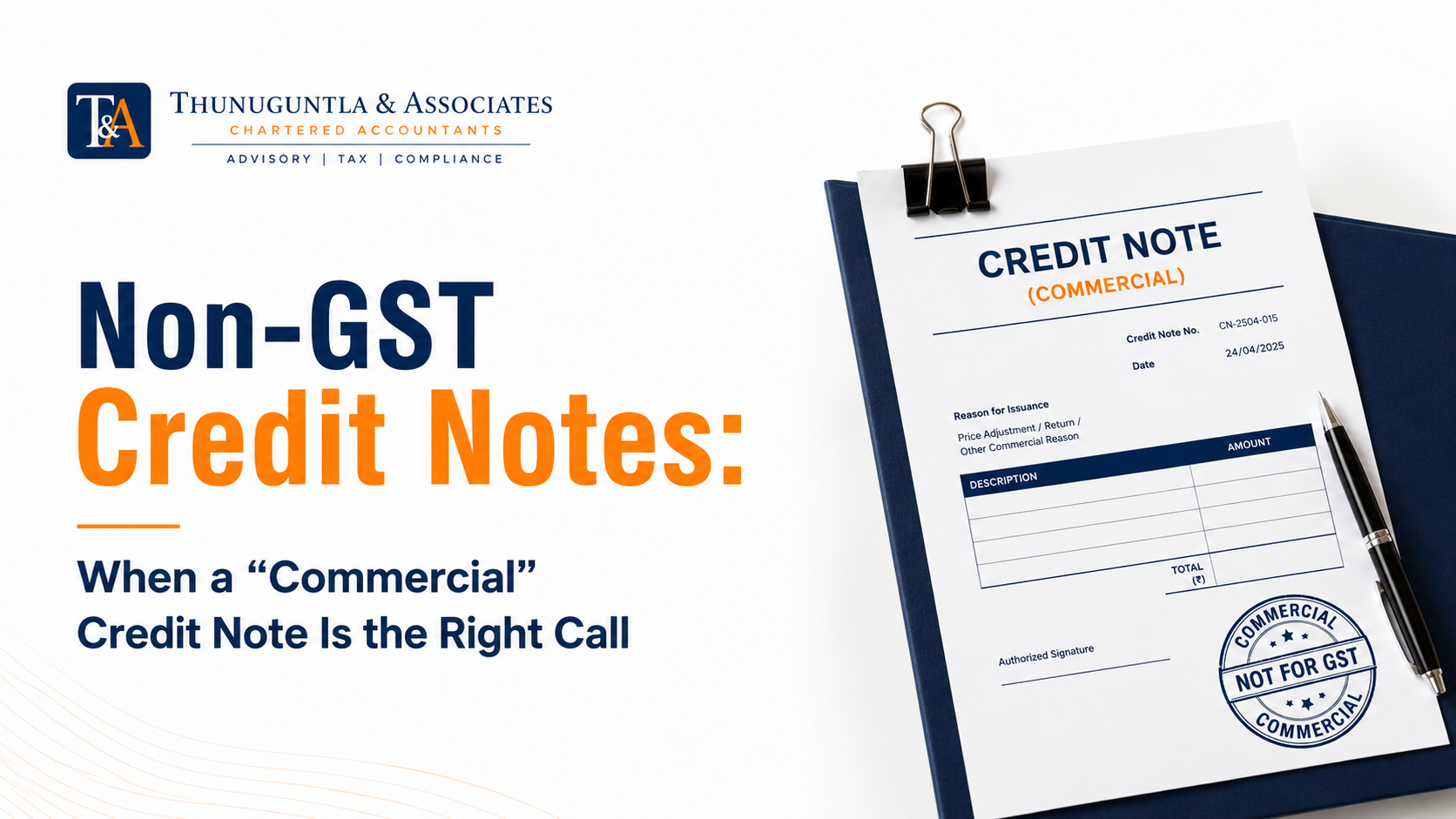
You have shipped goods, raised a tax invoice, and paid GST on it. Two months later, the buyer demands a discount for volume purchases, or you decide to pass on a year-end incentive, or a distributor negotiates a price protection claim. Your accountant asks the obvious question — do we issue a GST credit note or a commercial one? Get this wrong, and you either lose legitimate tax adjustment or attract a notice for wrongly reducing output tax.
The confusion is common because the GST law recognises only one type of credit note, but commercial reality throws up several situations where that one type simply does not fit.
What Section 34 actually permits
Section 34 of the CGST Act, 2017 allows a supplier to issue a GST credit note only in three situations — where the taxable value or tax charged in the invoice exceeds the taxable value or tax actually payable, where goods are returned, or where goods or services are found to be deficient. The credit note must be declared in the GSTR-1 of the month of issue (or by 30th November of the following financial year, whichever is earlier), and it reduces the supplier's output tax liability. Correspondingly, the recipient must reverse the input tax credit already availed.
Everything outside these three situations is not a GST credit note — even if it is called one on the letterhead.
Where financial (non-GST) credit notes come in
A financial credit note, also called a commercial credit note, is issued without any GST component and does not touch the supplier's output tax or the recipient's ITC. It is a pure accounting adjustment. You use it wherever the underlying transaction does not qualify for Section 34 treatment. In practice, this covers four common situations:
Post-sale discounts not agreed at the time of supply. Section 15(3)(b) of the CGST Act allows a discount to be deducted from taxable value only if it is established in terms of an agreement entered into at or before the time of supply, and is linked to relevant invoices. Year-end target incentives, ad-hoc trade schemes, and quantity rebates decided after the sale fail this test — the supplier cannot reduce his output tax through a GST credit note. A financial credit note is the correct route.
Volume or turnover discounts not linked to specific invoices. Even when the discount scheme is pre-agreed, if the credit cannot be mapped to particular invoices raised on the recipient, the Section 15(3)(b)(ii) condition breaks. Again, a commercial credit note is the answer.
Price protection, marketing support, and subsidy pass-throughs. These are contractual settlements, not a reduction in the value of an earlier supply. GST cannot be adjusted on them.
Time-barred adjustments. If the November deadline of the following financial year has lapsed for the invoice concerned, the GST route is closed. A financial credit note can still be issued to settle the commercial position.
What the CBIC has clarified
Circular No. 92/11/2019-GST dated 7 March 2019 laid the foundation — post-sale discounts not meeting Section 15(3)(b) can be issued through financial/commercial credit notes without any GST, and the recipient is not required to reverse ITC in such cases. More recently, Circular No. 212/6/2024-GST dated 26 June 2024 prescribed the mechanism for suppliers to demonstrate that recipients have reversed proportionate ITC where the discount does qualify under Section 15(3)(b)(ii) — reinforcing, by contrast, that where the mechanism cannot be met, the commercial credit note is the fallback.
Practical implications for your books and returns
A financial credit note does not appear in GSTR-1 and does not reduce your Table 4 output liability in GSTR-3B. It is booked in your ledgers as a discount or rebate expense (or as a reduction from sales, depending on accounting policy). The GST portion of the original invoice stays intact for both parties — you retain the tax collected, and your buyer retains the ITC.
For the recipient, this is important. There is no automatic ITC reversal obligation on a financial credit note, unlike a Section 34 credit note where reversal is mandatory. However, the recipient should treat the amount received as either a reduction in cost of purchases or as other income, based on the nature of the settlement.
Comparison at a glance
| Feature | GST Credit Note (Sec 34) | Financial / Non-GST Credit Note |
|---|---|---|
| Legal basis | Section 34 read with Rule 53 | Contractual / commercial |
| GST component | Yes, tax reversed | No GST charged |
| Supplier's output tax | Reduced | Unchanged |
| Recipient's ITC | Must reverse | No reversal required |
| GSTR-1 reporting | Table 9B | Not reported |
| Time limit | 30 Nov of next FY | No statutory limit |
| Typical use | Sales return, deficient supply, invoice correction | Post-sale discounts, incentives, price support |
Documentation you must keep
Issue the financial credit note on a serially numbered document clearly titled "Commercial Credit Note" or "Financial Credit Note" — never as "Credit Note under Section 34". State the reason (post-sale discount, incentive scheme, price protection), reference the underlying invoices where possible, and mention explicitly that no GST is being adjusted. Keep the scheme circular, dealer agreement, or board approval on file. This paper trail is what protects you when the department asks why an invoice-linked reduction was booked without GSTR-1 disclosure.
The takeaway
If the discount or credit does not sit squarely inside Section 34 read with Section 15(3)(b), do not force it into a GST credit note. Use a financial credit note, keep the GST component untouched on both sides, and preserve the underlying commercial agreement. That single decision — routing the entry correctly at the point of issue — is what stands between clean books and an avoidable Section 74 notice three years later.
CA Praneeth Thunuguntla | Thunuguntla & Associates | Income Tax & GST Advisory
Have Questions? We're Here to Help
Get expert advice from Thunuguntla & Associates. Reach out to discuss your requirements.