
Intermediary Services under GST: Section 13(8)(b) Omitted – A Landmark Shift for Exporters (Finance Act 2026)
Introduction
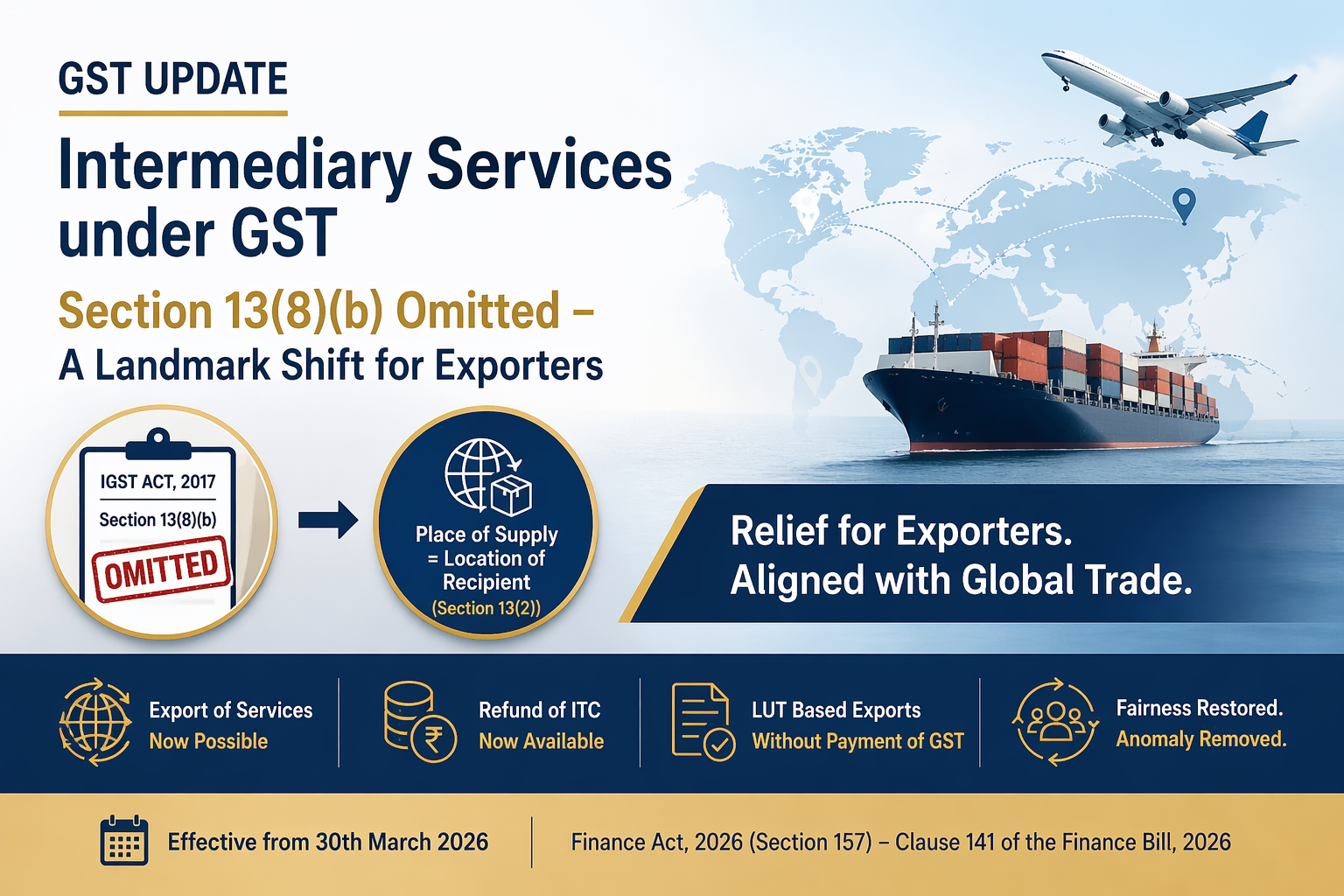
The Finance Act, 2026 has introduced a significant amendment by omitting Section 13(8)(b) of the IGST Act, 2017, fundamentally altering the tax treatment of intermediary services. This change directly impacts service exporters and resolves a long-standing anomaly in GST law.
Background / Legal Framework
Under Section 2(6) of the IGST Act, a service qualifies as export only if the place of supply is outside India. However, Section 13(8)(b) earlier created an exception by deeming the place of supply for intermediary services as the location of the supplier (i.e., India), thereby disqualifying such services from export status.
This resulted in:
-
Denial of export benefits (refund of ITC)
-
Mandatory GST levy (typically 18%) on services rendered to foreign clients
What is the Change / Update
-
Clause (b) of Section 13(8) has been omitted via Clause 141 of the Finance Bill, 2026 (now Section 157 of the Finance Act, 2026).
-
Effective date: 30th March 2026 (date of enactment)
-
Consequently, intermediary services now fall under the default rule of Section 13(2) (place of supply = location of recipient).
Need help with this? Talk to Thunuguntla & Associates →
Key Features / Highlights
-
Intermediary services to foreign clients can now qualify as export of services
-
Eligibility for:
-
Refund of accumulated ITC (Rule 89)
-
Export under LUT without payment of tax
-
-
Services received from foreign intermediaries will now qualify as import of services
-
GST applicable under Reverse Charge Mechanism (RCM) for Indian recipients
Practical Impact
-
Exporters (e.g., brokers, agents, sourcing facilitators) benefit from zero-rated treatment
-
Removes the earlier “tax cost without recovery” issue
-
Aligns GST with its destination-based taxation principle
-
However, increases compliance burden for Indian recipients of foreign intermediary services (RCM liability)
Risks / Caution / Alternative Interpretation
-
The amendment is prospective, not retrospective—past tax liabilities remain intact due to Sections 6 & 6A of the General Clauses Act
-
Classification disputes may intensify, Whether a service qualifies as “intermediary” vs “principal supply”
-
Potential departmental scrutiny on Contract structures and Nature of facilitation vs independent supply
Action Plan (What Should Taxpayers Do Now)
-
-
Identify whether services qualify as intermediary or principal supply
-
For transactions post 30-03-2026, consider export benefits
-
Ensure LUT is in place to export without payment of GST
-
Start claiming refunds for eligible export transactions
-
Evaluate inward services from foreign intermediaries
-
Maintain agreements, invoices, and foreign remittance proofs
-
Conclusion
The omission of Section 13(8)(b) corrects a fundamental flaw in GST law and provides long-awaited relief to intermediary exporters. While the amendment improves tax neutrality, it introduces new compliance considerations. Strategic evaluation is essential.
For expert guidance on this topic, contact your tax professional today.
Have Questions? We're Here to Help
Get expert advice from Thunuguntla & Associates. Reach out to discuss your requirements.